
Rikers Island, Queens
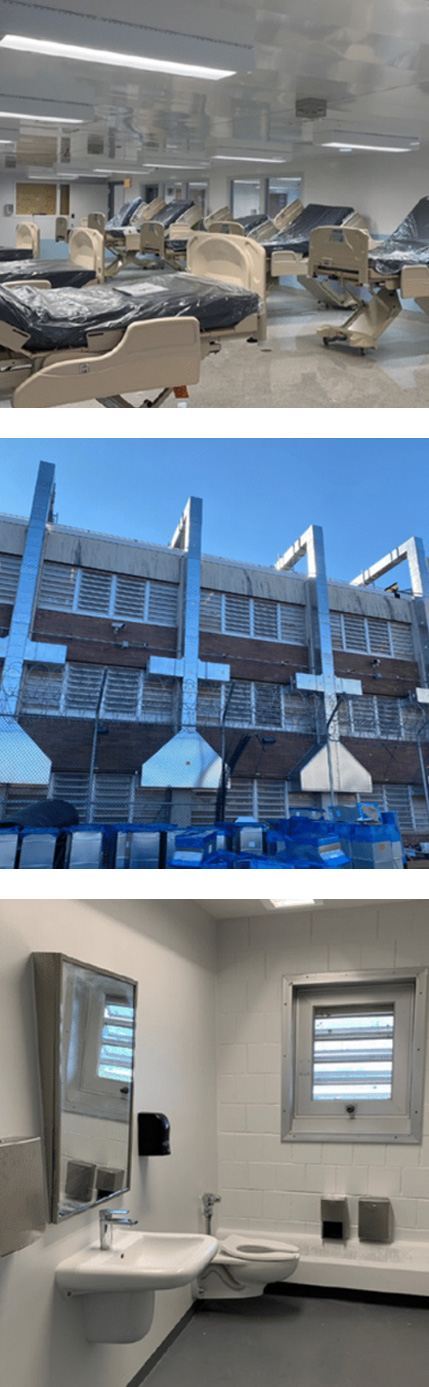
After an alarming rise in self-harm and injury among detainees on Rikers Is-land, the Mayor of New York issued an Emergency Executive Order declaring a state of emergency for the City’s 413-acre island detention complex. The Emergency Order synchronized a design and delivery team of Urbahn Archi-tecture, Padilla Construction Services, and Armand Corporation as the Con-struction Manager in a rapid response execution of an urgently needed, multi-building rehabilitation program. The work program concentrated on four primary scopes of work in various complex areas.
The original scope of work included the following buildings:
Primary among the challenges of this work was the expedited schedule for a massive rehabilitation program in a hyper-secure facility. Under normal building conditions, executing the $125 million scope of work might take two to three years. This emergency services contract extended the work schedule to just 11 months. Armand maintained a continual onsite presence through-out construction, staffing the project with construction professionals who understand how to dissect problems to find solutions. Given the post-COVID building market and supply chain pressures of 2022, virtually all the required HVAC equipment, many of the plumbing components, and other building materials became long-lead items within the critical path. Armand helped the procurement process by identifying secondary resource markets, seg-menting purchase orders among multiple vendors, and closely tracking material quantities and needs.
Unique among processes, Urbahn Architecture joined the project for this emergency services contract at the same time Armand and the general con-tractor did. This meant that Urbahn Architecture had to develop the design documentation required to build the work in essentially what became a de-sign-as-you-go process. The need to have permittable plans compelled the team to maintain daily project briefings via virtual meetings to discuss the day’s issues, the previous day’s resolutions, and the following day’s needs. Armand took a leadership role in project support by working with all team members to understand their challenges and support whatever deficiency may exist to keep the project moving forward as quickly and safely as possible.
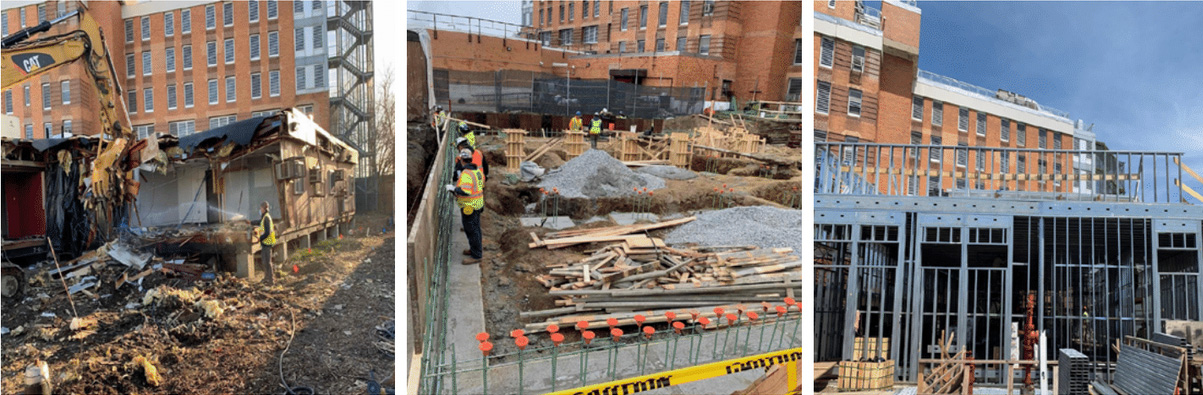
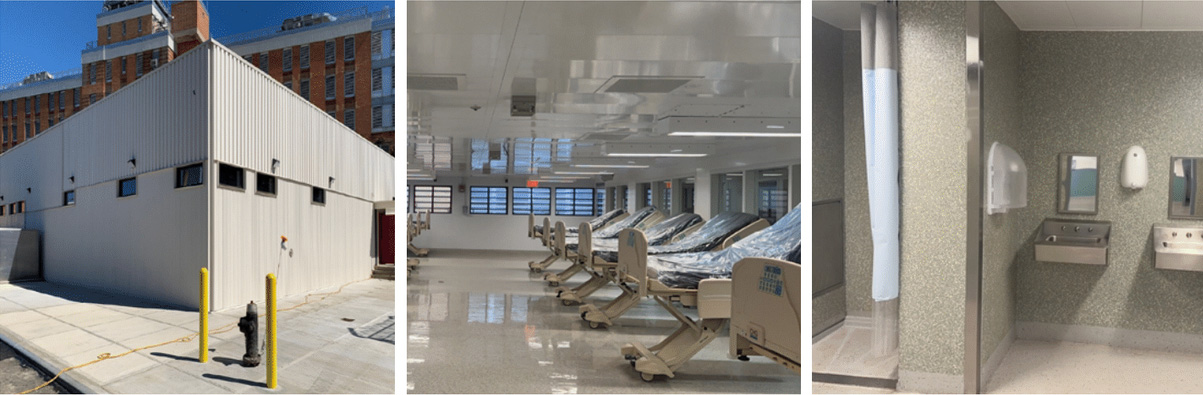
The North Infirmary Command building had to be demolished due to the condition of the building and a new metal prefabricated building was erected in its place.
The NIC Mod building was approximately 1,200 square feet. The building was to be used for the infirmary, office, and lockers for the Warden and Officers. The construction of the NIC Mod was fast paced, like the rest of the Rikers Emergency Project; as the new structure was expected to be completed in a few months. Armand was able to reach substantial completion in four months and final completion in five and a half months. Delays were encountered due to supply chain issues with lighting fixtures, fire alarm equipment, and HVAC units.
The following is a summary of the construction phase for the NIC building:
Continuing with a winning team …. Armand Corporation is an NYS-certified M/WBE construction management firm, and as such, we have a strong conviction to support our fellow M/WBE and SDVOB firms.
94% of the contract value was awarded to M/WBE firms on the Rikers Island project. Of the twenty-one (21) subcontrac-tors, fourteen (14) were MWBE firms. Sixty-four percent (64%) of the total subcontract value was awarded to M/WBE firms. In addition, there were three (3) prime contractors/consultants, and two (2) were MWBE firms. The total M/WBE contract value for those sixteen (16) firms brought the awarded contract value to 94% (or approximately $235M).
View other projects
New York City Department of
Design & Construction
$250M
New York City Department of
Design & Construction
Original Contract $125M
Current Contract $250M
Shamsell Abdill brings over 20 years of experience in the construction industry to her role as Vice President at Armand Corporation. She oversees the company’s building and infrastructure programs, serving as Project Executive, and is renowned for her expertise in contract administration, project management, problem resolution, and M/WBE compliance. Her career highlights include contributing to the rebuilding of the World Trade Center as part of the Procurement and Change Order Management Team, where she gained extensive experience in procurement and negotiation. Shamsell leverages her comprehensive industry knowledge to build strong professional relationships with agencies and utility companies, minimizing impacts on construction schedules. Her diverse project portfolio spans corporate, correctional, healthcare, educational, and landmark building restorations, as well as masonry renovations. She is adept in various project delivery methods, including construction manager as agent, construction manager at risk, design-bid-build, and design-build, making her an invaluable leader in delivering successful projects for Armand Corporation.
Robert “Bob” Mello is a seasoned construction professional with over 35 years of experience managing both new construction and renovation projects. As Associate Vice President of Pre-Construction at Armand Corporation, Bob specializes in overseeing planning and construction-related services for public and private clients.
A licensed Professional Engineer in New York State, Bob’s extensive expertise includes managing projects across urban environments and on-call contracts. His skill set encompasses facility planning, property condition assessments, constructability reviews, quality control and compliance, energy efficiency initiatives, and scope and schedule reviews.
Bob’s comprehensive approach ensures effective construction management from initial phases through project close-out, making him an invaluable leader in delivering successful outcomes for Armand’s clients.
CariAnn Palmese is a senior program manager with nearly 20 years of experience delivering program management and administrative support for large, complex, multi-million-dollar projects. Her expertise includes developing and implementing policies and procedures to ensure the successful execution of challenging initiatives.
A highlight of CariAnn’s career was guiding the Nassau County Department of Public Works in managing community reconstruction projects under a $36 million CDBG-DR capital program. Currently, she works alongside Armand’s team to provide construction management services for disaster recovery capital programs, showcasing her dedication to driving successful outcomes in high-stakes environments.
Jerome Wright is a seasoned financial analyst with nearly 20 years of accounting experience across diverse industries. As Associate Vice President of Operations at Armand Corporation, Jerome excels in managing and tracking vendor invoices, ensuring timely processing using project-specific templates, and providing hands-on assistance to vendors with invoice submissions.
Jerome’s expertise includes preparing detailed invoice summary reports for Program Manager approvals and collaborating with Program Managers to resolve billing discrepancies. He has a proven ability to reconcile financial data, comparing and correcting invoice details while working closely with project management and accounting teams to address invoicing issues.His commitment to precision and collaboration makes him an integral part of the operations team.
At Armand Corporation, We are committed to maintaining a secure and transparent hiring process. Please be aware of potential job scams that misuse our name to solicit sensitive or personal information. We do not request Social Security numbers, bank account details, or payment of any kind during the initial stages of the hiring process. Additionally, we never offer employment without a formal interview process. All applicants are required to participate in one or more interviews before any job offer is extended. While we may request verification of education, certifications, or licenses during the later stages of the hiring process.
If you receive suspicious communication claiming to be from Armand Corporation or are uncertain about the legitimacy of a job offer, please contact us directly at careers@armandcorp.com for confirmation. Protecting your privacy and ensuring a fair and professional hiring experience is our top priority.
Executive Vice President & Chief Operating Officer Phillip Grant is responsible for overseeing the company’s daily operations and driving the execution of strategic initiatives. He manages key relationships with stakeholders, including boards, owners, consultants, and contractors. Phillip is also responsible for negotiating contracts, resolving budget and schedule challenges, and integrating innovative technologies. He has over 20 years of extensive expertise in economic development, engineering, and public infrastructure. Phillip has successfully managed multi-billion dollar capital construction programs, focusing on sustainability, compliance, and efficiency. He is a licensed Professional Engineer in New York, a Certified Construction Manager and holds a BS in engineering from Fairleigh Dickinson University and an MBA from Mercy University. He is also a member of the Construction Management Association of America, National Society of Professional Engineers, and the American Society of Civil Engineers.
